
Food Clock
01
A smart food management app that reduces waste and inspires mindful cooking.
#SpeculativeDesign
#UXDesign
#sustainableDesign
#Food
#AI
Food Clock is a mobile app that helps users efficiently manage food stored in their fridge, track expiration dates, and discover personalized recipe suggestions based on what's available. The design aims to reduce food waste, ease grocery planning, and foster healthier eating habits.
Problem:
Many households waste food due to:
-Untracked expiration dates
-Forgotten ingredients
-Lack of meal inspiration
Food Clock addresses this by visualizing food shelf-life, surfacing smart recipe recommendations, and syncing with user fridge inventories.
Goals
Help users track expiry dates.
Provide recipe suggestions using available ingredients.
Reduce food waste through timely consumption.
Offer a visually intuitive interface for all age groups.
Tools :
Figma – UI design, layout, and prototyping
Illustrator / Photoshop – Image editing
Dale-e – Image Generation
Design System & Decisions
Color Coding: Intuitive color psychology—orange/red for urgency, green for freshness.
Typography: Clean sans-serif font for readability.
Visual Recipe Cards: High-quality imagery and overlayed metadata for quick scanning.
Prototype
User Research
Objectives
1. What are the motivations and priorities behind food purchases in households?
2. How do people around the world manage their food at home, and why does it fail sometimes?
3. Can we connect food waste directly to life patterns like time scarcity, diet goals, or emotional eating?
Methods Used
Conducted 6 semi-structured interviews . Focus was on shopping habits, food storage behavior, and cooking routines.
Key Insights
KEY THEMES FROM INTERVIEWS & RESEARCH
1. Conflicting Priorities
a. Health, budget, taste, time, and convenience all compete for attention, making it hard to stick to zero-waste habits.
b. Without systems in place (like meal planning or proper storage), even the most conscious households struggle to prevent waste.
2. Cultural Norms and Attitudes
Cultural background influences food waste behavior significantly.
These ingrained attitudes shape individual behaviors more than personal values Do.
3. Time Scarcity and Lifestyle Pressure
Even people who enjoy cooking or value sustainability often end up ordering food or eating out due to time constraints.
Food bought for cooking gets pushed aside when convenience becomes the priority.
4. Fridge Organization and Visibility
Well-organized fridges reduce food waste by making it easier to see what’s available and needs to be used.
Both interviews suggest that food is more likely to be consumed when it’s visible and tracked.
5. SUMMARY OF FINDINGS
Food waste is not caused by a lack of awareness but by conflicting priorities.
People aim to eat healthy, save money, but these goals often collide with time limits, forgetfulness.
Planning systems, and better food visibility (organized fridges, smaller portions) are key to reducing household food waste.
Design Canvas
Problem:
Food Waste
Expiration date
Lack of priority
Busy Schedule
Lack of connection to share
User and customers:
Young adults
Working men or women
Singles
Solution:
A "food clock" that shows how long each food item will last before it expires. Users can share their extra food with others in their community through the app. When a user shares food, they earn reward points, which they can redeem to get food from others when they’re in need. This creates a cycle of giving and receiving, promoting community sharing and reducing food waste.
User needs:
Cheap
Quick to do
Less cognitive load
Simple solution
Education
Rewarding to motivate
Effortless sharing to needful
Vision and Mission:
Reduce consumption, waste, mindful monitor, increase sharing.
To create a easy, cheap, accessible digital product to helps in trash reduction as maximum as possible by meduim of sharing and creating habits to buy less.
Value Proposition:
Helping households better manage their food inventory and prevent spoilage.
Raising self awareness about food waste through mirroring data.
Providing access to deeply discounted food items nearing expiration from partner stores.
Competitors:
Too Good To Go
Flashfood
Food rescue us
No waste
Wireframing
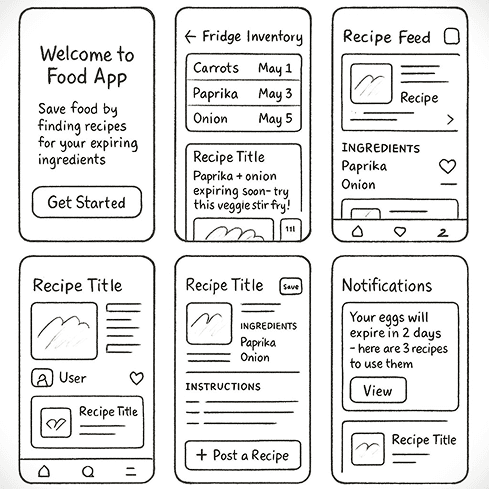
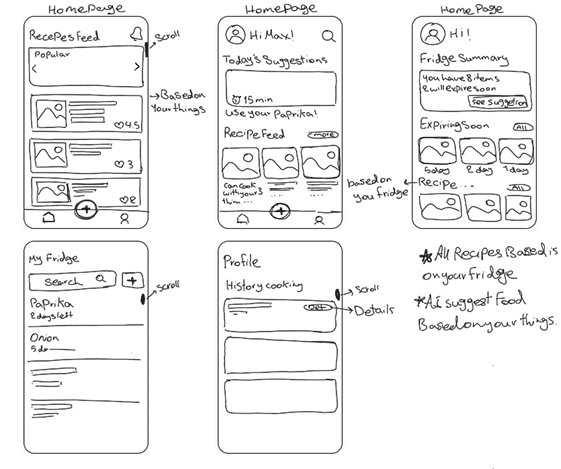
Aesthetic Strategy
Color palette
Green- Freshness
Red- Alertness
Yellow- Neutral/ Out of danger
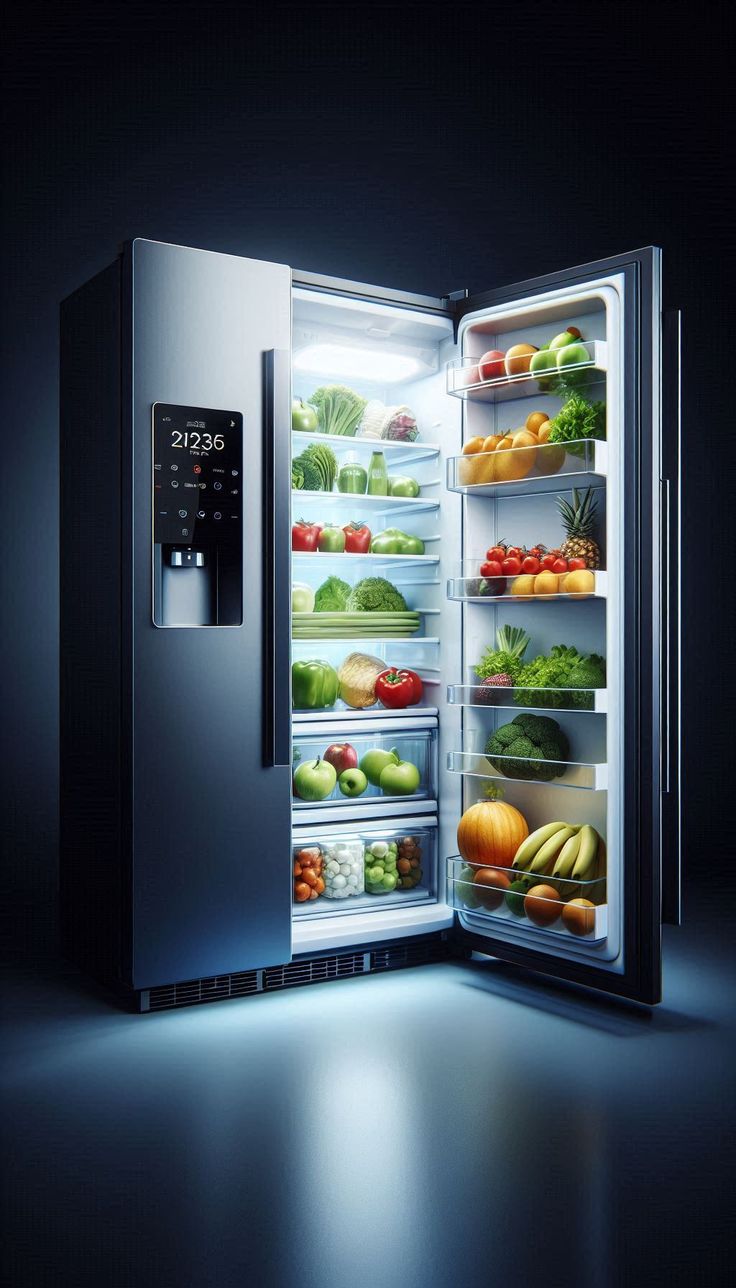
Transparency effect- Glass personality of refrigerator
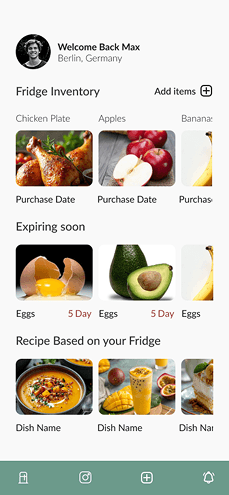
Features & Interaction Model
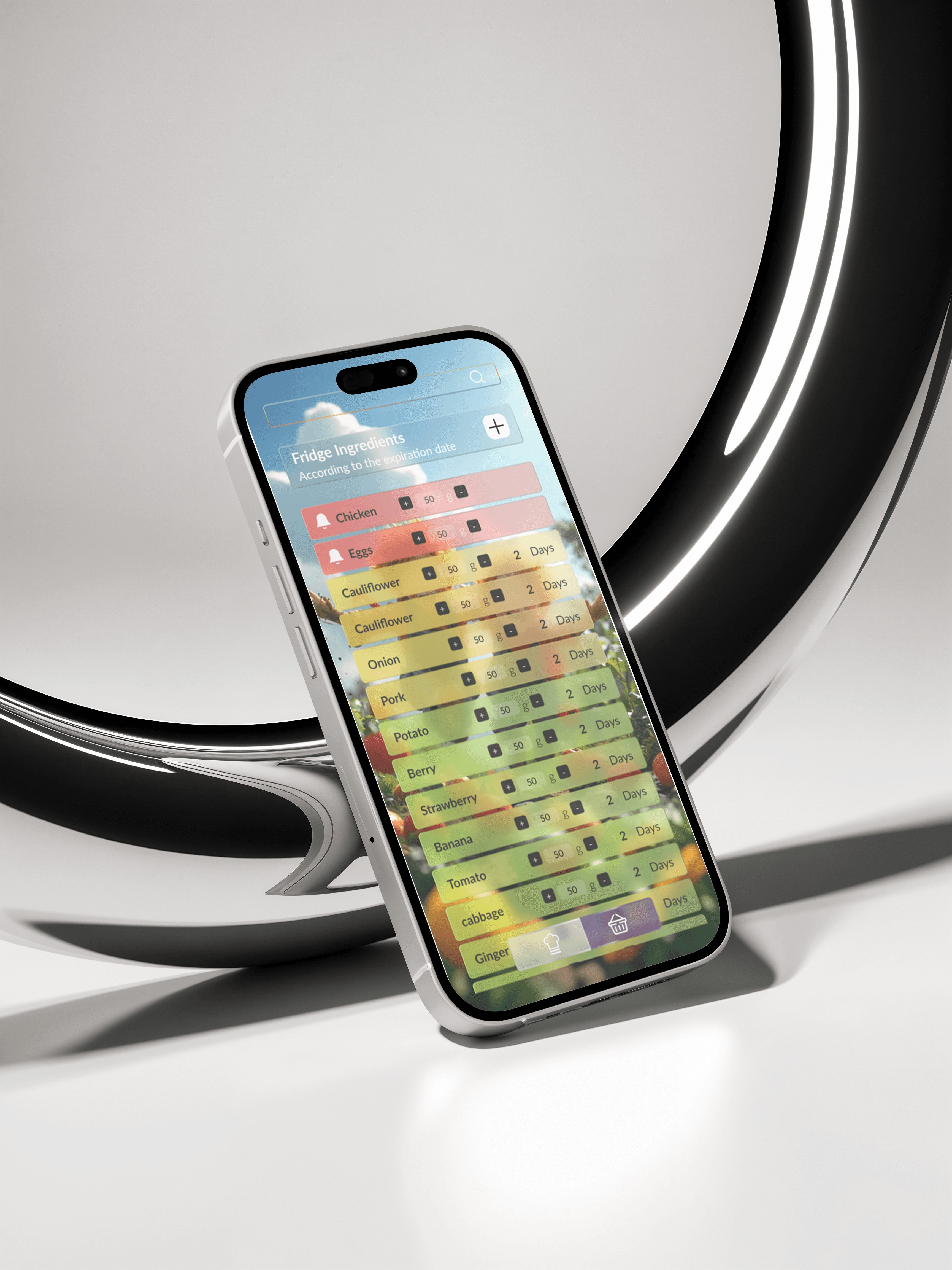
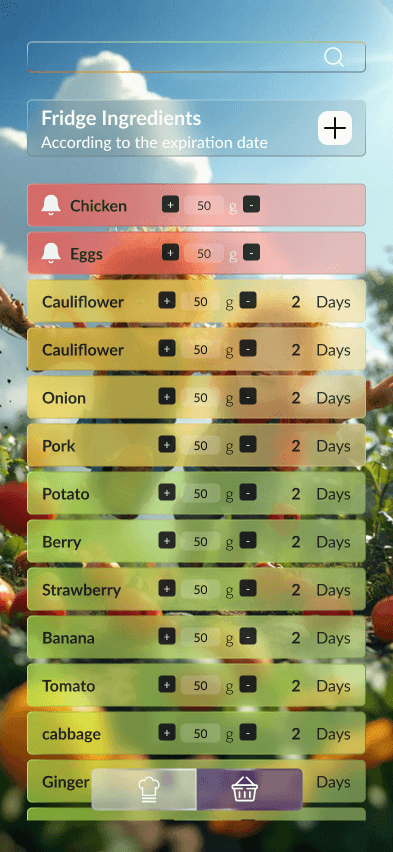
1. Fridge Inventory Tracking
Shows all stored ingredients with expiration countdown (e.g. “2 Days Left”) in a acending order
Color-coded freshness system (Orange → Urgent, Yellow → Medium, Green → Fresh)
Option to add recently bought ingredients
Option to discard/recieve the notification of to be expired soon food ingredient
Search bar in top centre to search ingredients in the inventory
2. Home- Ingredient-Based Recipe Matching
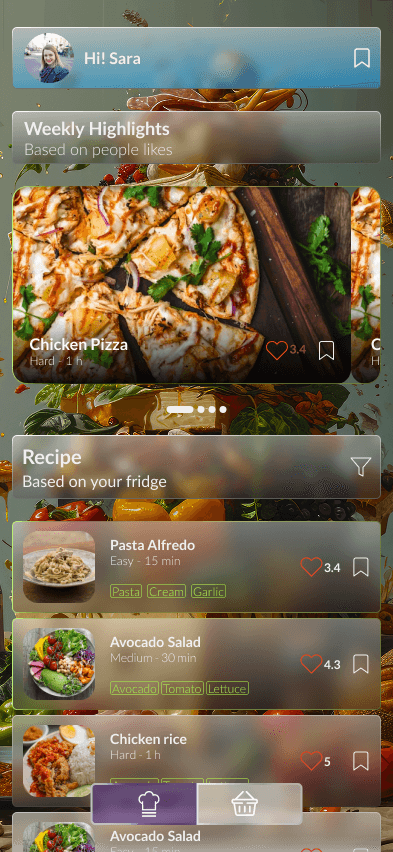
Recipes are recommended based on the current fridge stock.
Filter overlay to search the recipe for specific ingredient.
Ingredients already available are highlighted.
Missing items are greyed or unchecked.
Weekly highlights based on community likes
Recipe browsing sorted by popularity and availability

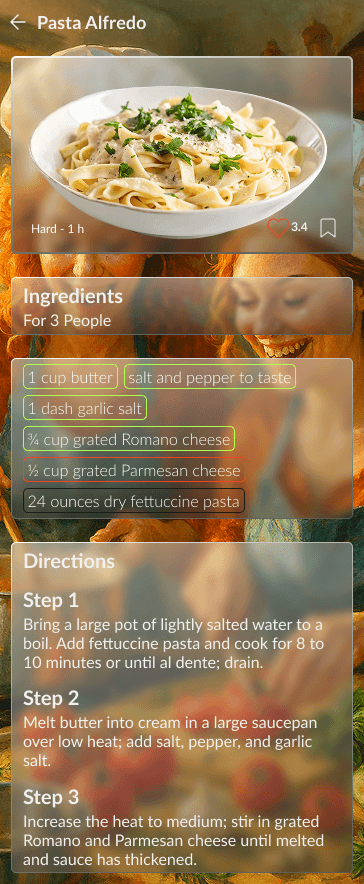
3. Recipe Detail Overlay
Visually rich recipe cards with preparation time, difficulty, and favorites.
Clear, step-by-step directions.
Real-time visual feedback and community argument threads
Highlight the available ingredients, fresh items, about to expire soon, out of stock ingredients.

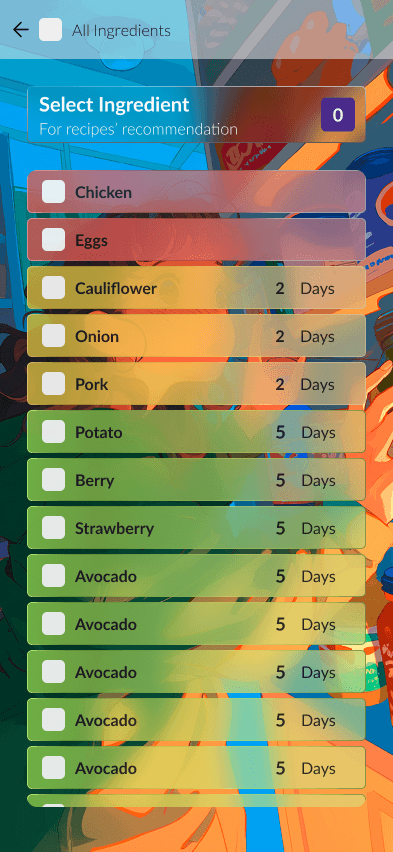
4. Smart Selection Panel
Users can manually select ingredients to get recipe suggestions
Ideal for using leftovers or surplus items

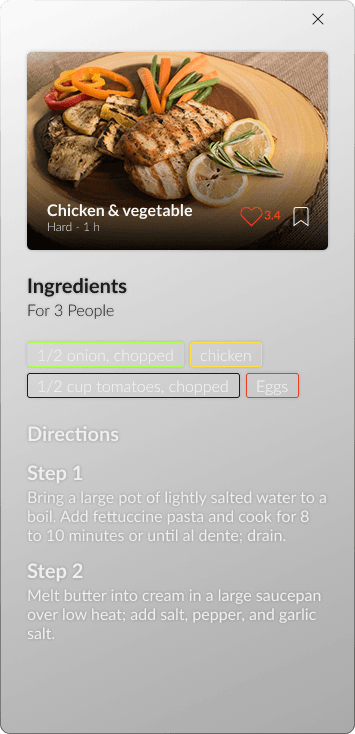
5. Ingredient Selection based recipe
Users get recipe suggestions for manually selected ingredients with direction to cook.


Mitbringen
02
Reconnecting Rural Youth: Experience Design for Low-Density Communities
#SpeculativeDesign
#organicproduce
#Socialinfrastructure
#ruralarea
#rural-urban-design
#farmer
#Socialinnovation
#Governancemodel
Role:
Time:
Tools:
Raw tool:
Type of work :
Service Designer
Jan 2025- Jul 2026
Claude Design LAB
Paper Prototype/wireframe
Academic Research + Speculative design + Hi- Fidelty Prototype
Problem:
The rural Areas in Europe are inclined to shrink constantly after the advancement of urbanization, causing youth and native to shift to neighbor cities, living behind gaps in social communities- causing social order disruption- to get acess to better infrastructure to live and make living.
One of those Infrastructure issue is faced by Small-scale rural producers in Germany ,who are increasingly cut off from the urban consumers who want what they make. Reaching a city market means navigating logistics costs and distribution networks built for industrial-scale operations — a barrier that quietly favours large producers and squeezes out the small farmer, impacting rural lives and local rural community.Meanwhile, thousands of private cars travel between rural areas and cities every day, mostly empty of anything but their drivers.
The infrastructure to close that gap already exists. What's missing is a way to coordinate it that doesn't simply hand another margin to a platform middleman — repeating the extraction that has hollowed out rural participation in the first place.
Mitbringen addresses this by investigating the social studies, social innovation design theories, and through the comparative analysis of the pre-existing social services. Moreover, it critically examine the governance structural gaps of social services.
The position
Most platforms designed around social good reproduce the conditions they set out to address. They optimise for scale, extract value from participation, and embed market logic beneath a cooperative surface. This project begins with that critique — and asks what design looks like when governance is not a legal afterthought but the primary design constraint.
Method
The research draws on critical political economy and social innovation theory to examine how infrastructure — specifically the infrastructure connecting rural producers to urban consumers — can be structured around civic trust rather than transactional efficiency. The field context is Germany: a country with mature cooperative traditions, significant rural-urban mobility, and persistent structural inequalities in who benefits from emerging logistics platforms.
Rather than proposing a service that mimics existing sharing economy models, the thesis develops a governance framework first. Each governance principle is treated as a design decision: determining what the system can and cannot do, who it recognises, how it distributes value, and what kinds of participation it makes legible. The interface is the visible surface of those decisions — not a skin applied afterward.
Outcome
The outcome is a high-fidelity interactive prototype demonstrating the full platform experience across multiple user communities — each with distinct motivations, access conditions, and roles within the system. The prototype shows how a trust-based governance structure produces a specific interaction quality: one that differs materially from gig economy interfaces not in its aesthetic register, but in its structural logic.
This is speculative practice grounded in critical research. It is not a startup pitch or a market-ready product. It is a design argument — one that uses form to make a structural claim legible, and asks whether civic infrastructure can be designed with the same rigour we apply to commercial platforms
Governance-to-design mapping

Wireframe

Design decisions & Interaction Model
0. Onboarding
User choose role, to be a member of community not just service user.
The design allows multiple role to play within the community.

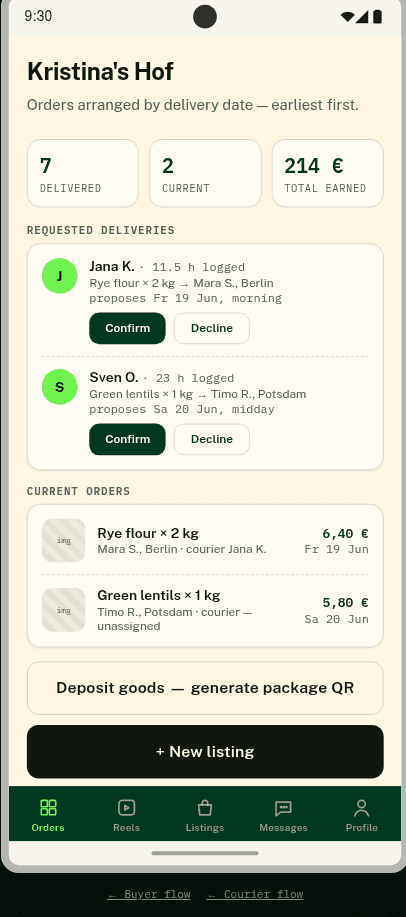
1. Seller state flow & design decision
Producer / Seller (Actor B)
Listing creation makes the farming-method narrative mandatory — it feeds the buyer's trust page.
Pricing is farmer-set, anchoring the fair-pricing principle.
Producer records condition at deposit, anchoring the liability-shift logic downstream.
A custody touchpoint lets B see who holds their good and its verified condition at each stage.
2. Buyer state flow & design decisions
Buyer (Actor A)
Two discovery modes: general browse and need-specific search.
Product detail page is the trust screen — farming method and provenance is the hero, not a footnote.
Checkout carries a switchable exchange: money or in-kind organic produce.
Seller profile includes a "visit/connect" affordance — produce as social infrastructure, not just a transaction.

3. Delivery actor state flow
Courier / Delivery Actor (Actor C)
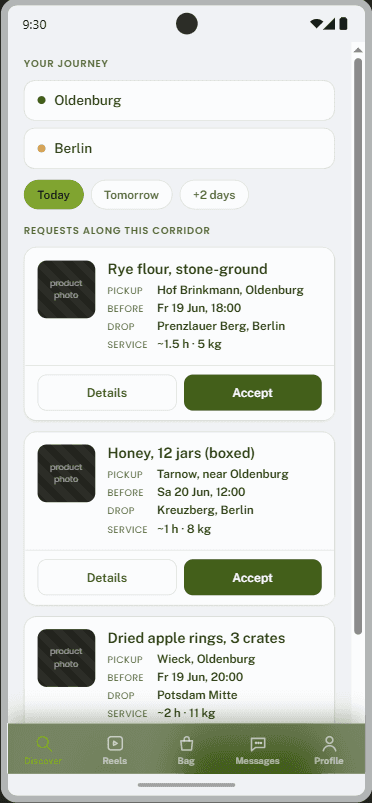
The richest flow — built as an event-driven state machine surfaced as a screen sequence.
Route discovery is pre-travel and planned (origin → destination → date), not on-demand.
Compensation is indirect by design: Ehrenamtskarte credits, mobility and liability shields — never cash-first.


Proba
03
Slowing emotional contagion through logic-driven interface design
#SpeculativeDesign
#UXDesign
#NeuroDesign
#Misinformation
#AI
A speculative interface designed to delay emotional reactions to fake news. By integrating real-time coherence scoring, sentiment dampening filters, and logic-based interaction locks, this project challenges the viral logic of misinformation and reimagines how truth might be earned in digital spaces.
Problem:
Emotionally charged fake news bypasses cognitive reasoning, triggering impulsive social reactions (e.g., riots, conspiracy propagation).
Behavioral Insight:
Based on neuroscience research, the amygdala responds before the prefrontal cortex can evaluate. Current news interfaces amplify this imbalance.
Design Opportunity:
Build a speculative tool that delays emotional impact, invites logic, and reprograms digital trust.
Speculative Premise
What if we could delay the emotional response triggered by misleading news by embedding logic-based doubt directly into the interface?
Emotional intensity triggers UI dampening
Logical coherence is rewarded with visibility
Belief is no longer automatic — it’s earned through structure
Tools :
Framer – UI design, layout, and prototyping
Illustrator / Photoshop – Image editing
Prototype
Features & Interaction Model
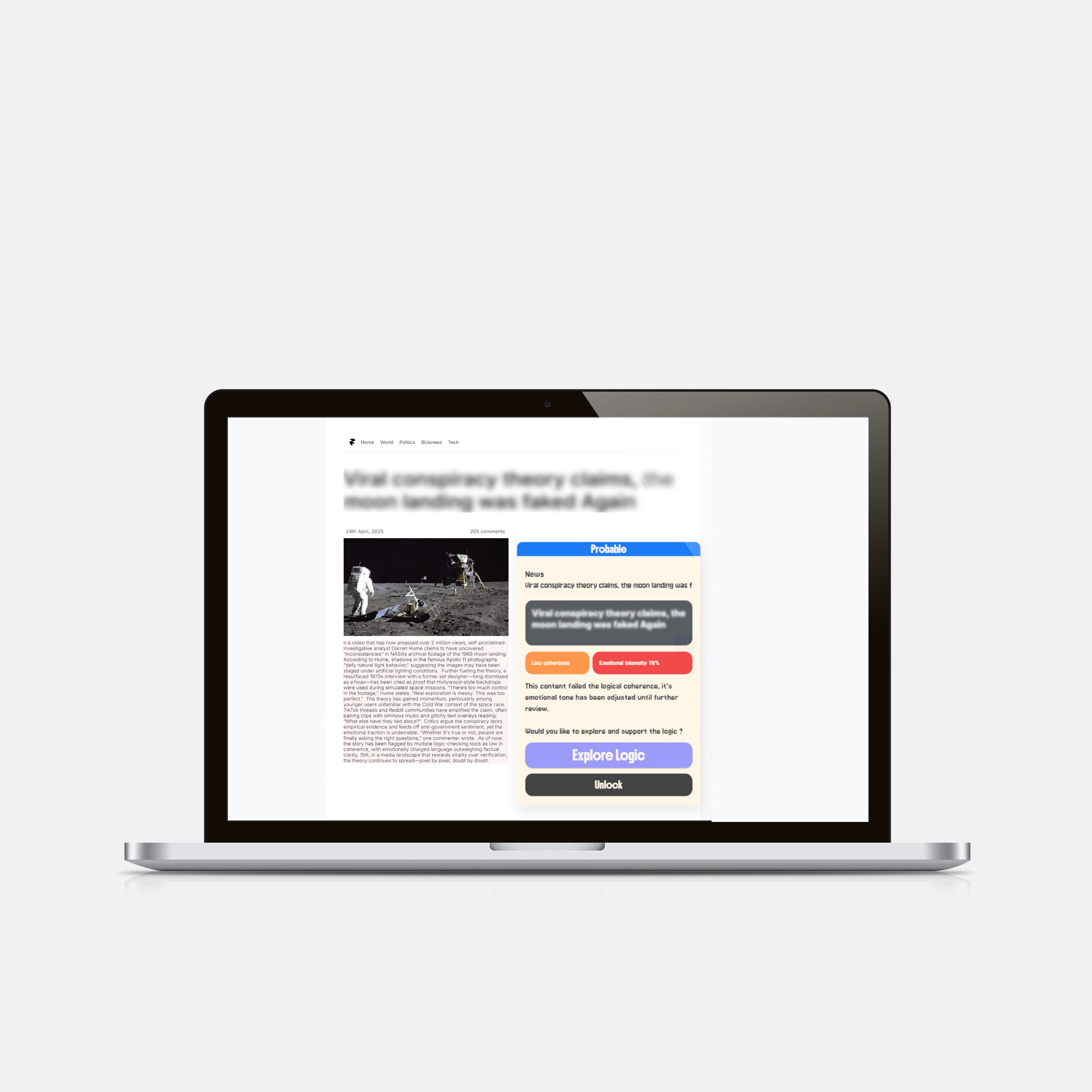
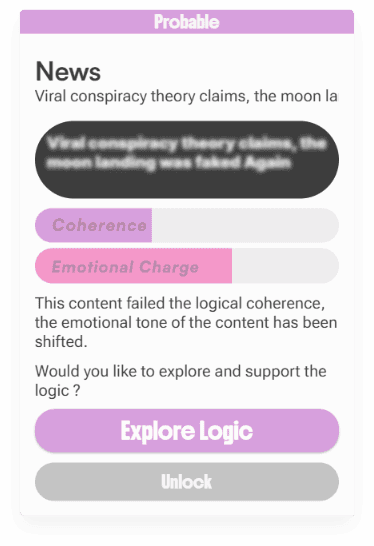
1. Coherence Score Engine
Analyzes headline + arguments using syllogistic logic
Visual: 0%–100% logic confidence
Flags fallacies, contradiction, or irrelevant premises
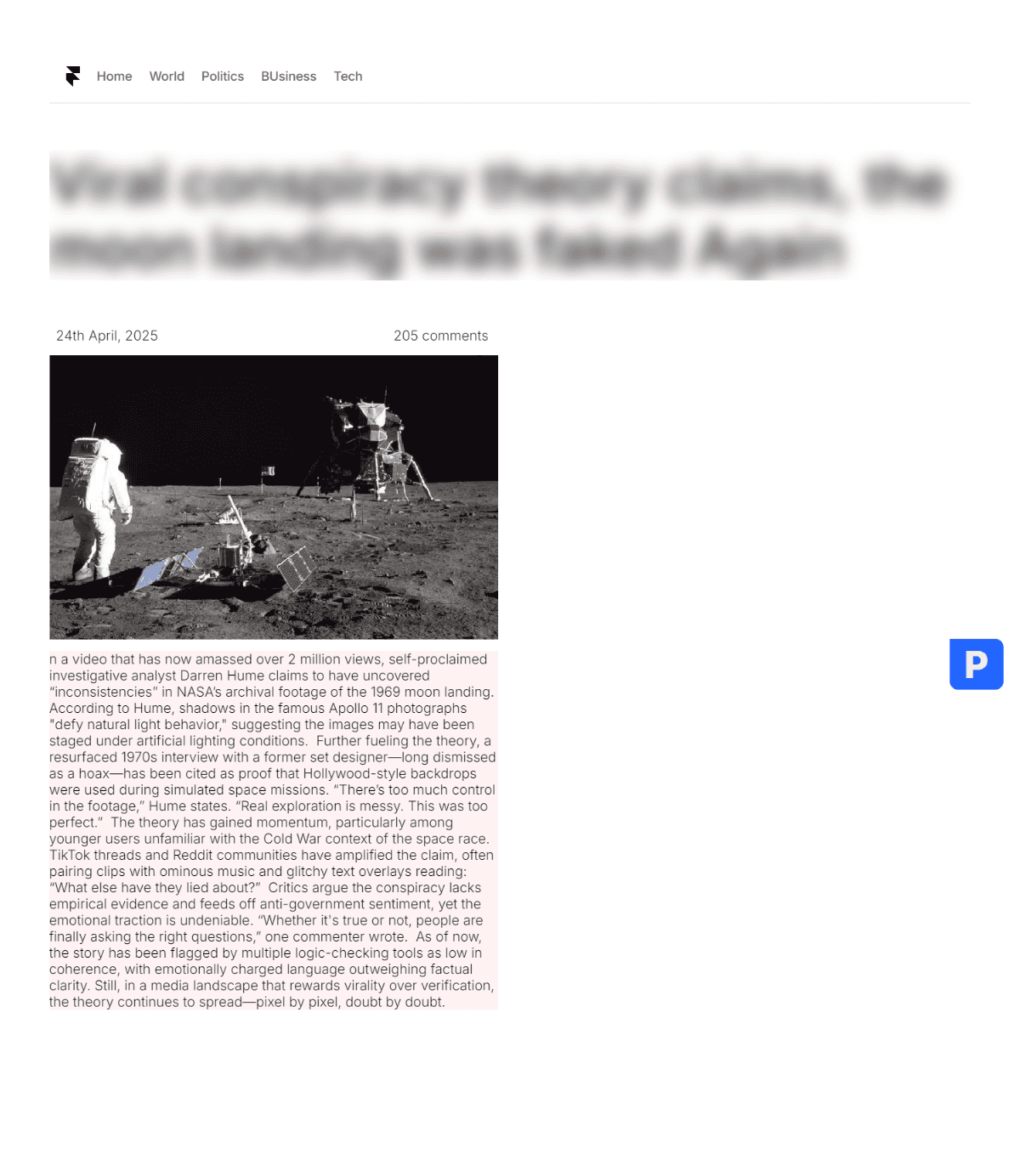
02. Sentiment Dampening Filter
Blurs emotionally charged phrases if coherence is low
UI adjusts tone, softens colors, and delays impact
Flags fallacies, contradiction, or irrelevant premises
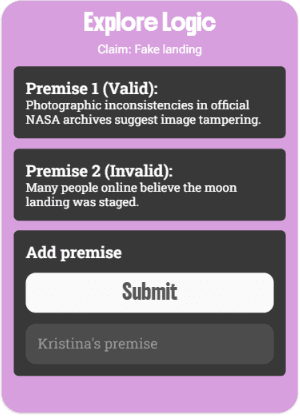
3. Explore Logic Overlay
Structured argumentation interface (Premise 1, Premise 2, Conclusion)
NLP parses arguments, gives validity check
Real-time visual feedback and community argument threads
4. Time-Locked Emotional Content
User must engage in reflection or view logic summary to unlock
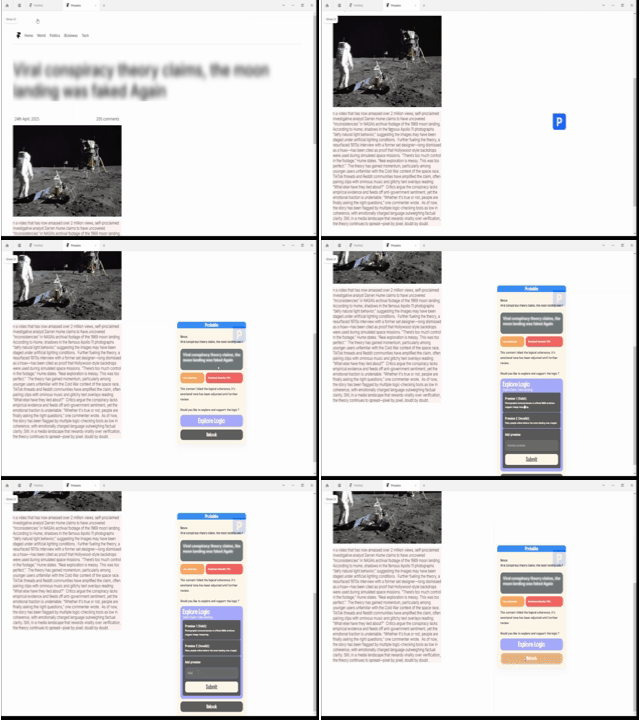
5. Landing page
Landing page design
Blurred headline state
Logic gate interaction
Sentiment dampening in action
Sentiment dampening in action

Social Count
Unfinished
04
An emotional analytics tool that decodes your digital conversations to reveal the hidden patterns shaping your closest relationships.
#SpeculativeDesign
#UXDesign
#sustainableDesign
#Relationship
#AI
Social Count is a speculative relational analytics tool that mirrors private chat data (e.g., WhatsApp) to visualize the emotional climate and interaction dynamics between two individuals over time. It does not predict feelings but interprets patterns in tone, reciprocity, and emotional behavior—encouraging reflection over confrontation.
2. Core Vision
Enable individuals to monitor and understand the emotional trajectory of their relationships.
Identify warmth, silence, overload, distance, or dependency loops through subtle clues in chat patterns.
Empower users to spot early signs of imbalance or toxicity before they escalate.
3. Visual Language
Use blended color gradients for mixed messages (e.g., red-yellow for passive-aggressive tones).
Silence indicators: Gray bars between active conversation clusters.
Topic shifts: Icon markers when discussion moves to external subjects (third person, events).
Mirroring Visualization: Two colored bands (User A and B) shifting over time—overlaps and gaps are interpreted.
4. Tools :
Figma – UI design, layout, and prototyping
Dale-e – Image Generation
5. Ethical Focus
Designed not for surveillance, but for self-awareness.
Gives users full control over their data, with local encryption.
Avoids scoring personalities—instead reflects interaction quality.
Warns of emotional projection or misreading, allowing interpretation to remain open-ended.
Features & Interaction Model
1. Sentiment Decoding
Messages are analyzed into emotional tones: positive, neutral, negative.
2. Interaction Timeline
Color-coded emotional timeline showing relationship pulses over time.
3. Symmetry Analysis
Tracks mutual effort: who initiates, who sustains, who withdraws.
4. Meta-conversation Flags
Identifies indirect communication patterns like avoidance, third-party projection, or emotional redirection.
5. Relational Health Score
A cumulative index updated weekly based on sentiment balance, response time, and topical focus.
6. Use Cases
Detecting a decline in emotional support from a close friend or partner.
Understanding the difference between external stress reflection vs. actual relational neglect.
Observing one’s own compulsive or avoidant behavior over time.
Highlight the available ingredients, fresh items, about to expire soon, out of stock ingredients.